Wednesday, January 7, 2015

Please welcome guest contributor Garrett McCord as he shares this recipe for a Chinese American favorite, hot and sour soup. ~Elise
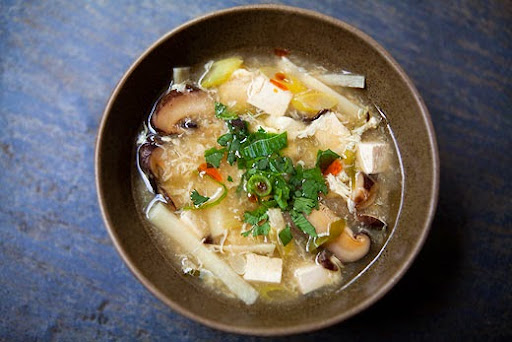
Hot and sour soup is a lot like chili; every family has their own recipe, and each family thinks that theirs is the best. When I was in the local Chinese market perusing the mushrooms I asked one of the other shoppers, a tiny and ancient woman half my height whose etched wrinkles framed a friendly smile, where the wood ear mushrooms were.
“What are you using them for?”
“Hot and sour soup,” I replied.
“What? You don’t want those. Here,” she grabbed a bag of dried shiitake, “use these.”
“No! You don’t want those for hot and sour soup!” cried another, more stout lady behind me. She said something in Cantonese to the first lady before grabbing a fresh bunch of enoki mushrooms and throwing them in my basket. “This is better.”
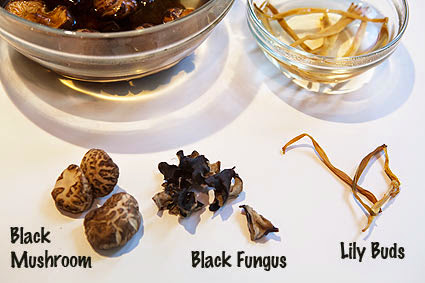
Soon, nine women were having an all out argument in the middle of the aisle. I was stuck in the middle, caught between volleys of angry insults and defenses of cherished family recipes for hot and sour soup, both in Cantonese and English. People insulted each other’s families, critiqued the various provinces of China (all were in agreement that the people in the North, apparently, can’t cook good soup), and altered the contents of my shopping basket at whim. Eventually, a decision was reached that you absolutely have to use black fungus – an apt, but unappetizing name for a delightful ingredient – and lily buds. The other mushroom is up to you. Whatever one you decide on be sure to be ready to defend your choice.
Hot and Sour Soup Recipe
Yield: Serves 4.
You can use gluten-free soy sauce in this recipe, and use vegetable stock to make it vegetarian. However, do not substitute black pepper for the white pepper. The mushrooms and lily buds can be found at any Chinese market.
Ingredients 6 dried Chinese black fungus 6 dried wood ear, black, cloud, straw, or shiitake mushrooms, or one bunch of fresh enoki mushrooms 5 dried lily buds One can of bamboo shoots 2 tablespoons of red wine vinegar 1 tablespoon of white vinegar or rice vinegar 1 1/2 tablespoons of soy sauce 1 tablespoon of cornstarch 4 cups of chicken broth (use gluten-free broth for gluten-free version) 1/2 block of firm tofu, diced into small cubes 1 egg, beaten 1 teaspoon of sesame oil 3 scallions, diced 1/4 teaspoon of salt 1 1/2 teaspoons of finely ground white pepper 1/4 teaspoon of chili oil (optional) Cilantro (optional)
Method
1 Pour boiling water over the mushrooms until the mushrooms are covered and allow them to soak for 20 minutes, turning the mushrooms over occasionally. It may not seem like a lot but they will grow quite a bit. After soaking remove any woody ends with a knife. Cut mushrooms into strips. Reserve 1/4 cup of the liquid and mix with the cornstarch. (If using fresh enoki mushrooms set aside as they do not need to soak).
2 Pour boiling water over the lily buds until covered and allow to sit for 15 minutes. Cut the buds crosswise then tear them up into a few bunches.
3 Mix the vinegars and soy sauce together and set aside. Open the can of bamboo shoots, drain well, and cut the shoots lengthwise into strips.
4 Place the chicken broth into a bot and bring to a boil over high heat. Add the tofu, mushrooms, lily buds, bamboo shoots, vinegar mixture, and cornstarch mixture. Mix and bring back to a boil. Once it comes to a boil remove from heat. While stirring the soup slowly pour the egg into the broth in a small steam while stirring the soup allowing the egg to instantly cook and feather into the soup.
5 Add the scallions, white pepper, sesame oil, and chili oil if using. Taste and adjust white pepper, vinegar, and salt to taste. Add cilantro to garnish and for added flavor. Serve immediately.
Hello! All photos and content are copyright protected. Please do not use our photos without prior written permission. If you wish to republish this recipe, please rewrite the recipe in your own unique words and link back to the source recipe here on Simply Recipes. Thank you!
Read more »

Tuesday, December 30, 2014

Please welcome my dear friend, guest author Steve-Anna Stephens as she shares a favorite treat, Chinese Chews. ~Elise

Every now and then, I just have to bake something. Anything.
It’s almost always more about the baking than the eating. So, you’ll find me walking around the neighborhood, knocking on doors, and giving whatever it is away. Perhaps due to an unusually large spate of baking on my part, one of my neighbors has been passing up my offerings of sweetsand homemade buttermilk biscuits, saying, “No thanks, I’m good.”
Now that’s a sad experience, having your baked goods declined.
So, when I asked the other day if he would like “some more of those date and walnut squares with powdered sugar,” and he said, “Sure,” I knew these Chinese Chews were a hit.
Chinese Chews have been a favorite in our family for years, but try as I might, I could not find the source for the recipe. A little digging revealed that the recipe for Chinese Chews first appearedin the June issue of Good Housekeepingin 1917. This version, handed down to me by my mother, varies only slightly from the recipe that was published during World War I. It includes an extra egg, calls for sifting the dry ingredients, beating the eggs well, and topping the squares with confectioners sugar (rather than forming them into balls and rolling them in granulated sugar).
What’s best about Chinese Chews is that while they are undeniably chewy, they aren’t overwhelmingly sweet. The crunchy walnuts add a nice balance to the texture, and the confectioners sugar sends a message to your mouth that they are, indeed, a dessert—not a health food bar.
There are many variations on the recipe for Chinese Chews, and perhaps just as many guesses as to why they are called Chinese Chews. There’s nothing noticeably Chinese about them, so that remains a mystery. Some versions of the recipe call for butter, brown sugar, vanilla, and even coconut. Others switch out the walnuts for pecans, and toast the nuts.
What’s your favorite way to make Chinese Chews? Please tell us in the comments. If you haven’t tried this popular, chewy dessert, you’re in for a treat. Your neighbors might like them, too!
Chinese Chews Recipe
Yield: Makes about 3-4 dozen squares, depending on the size of your squares.
Ingredients 3/4 cup all purpose flour 1 cup sugar 1 teaspoon baking powder 1/4 teaspoon salt 1 cup chopped dates 1 cup chopped walnuts 3 eggs, well-beaten Confectioners sugar, for topping
Method
1 Preheat oven to 300° F. Grease and flour an 8 x 12-inch pan – if you use a smaller pan, the baking time will be longer. Note: If you grease the pan, but don’t flour it, the squares will stick to the pan and be difficult to remove after baking.
2 Combine flour, sugar (not confectioners sugar), baking powder and salt. Sift with a sifter or fine mesh sieve into a medium sized mixing bowl. If you don’t have a sifter, whisk dry ingredients together well to combine.
3 Stir the dates, nuts and well-beaten eggs (I beat the eggs separately with a hand mixer for about 1 minute until fluffy before adding them), into the dry ingredients. It is not necessary to beat the eggs with a mixer, you can beat them by hand with a fork. Make sure ingredients are well combined – the batter will be sticky.
4 Spread the batter out as thinly as possible into the prepared pan.
5 Bake for 30 minutes, or until top is golden brown and a toothpick inserted in the center of the pan comes out clean.
6 Let cool completely, and cut into 1 to 1 1/2-inch squares. Note: Many recipes call for cutting the squares while still warm. In my experience, they are much easier to cut after they’ve cooled.
7 Sprinkle with powdered sugar, using sifter or sieve, as desired.
Hello! All photos and content are copyright protected. Please do not use our photos without prior written permission. If you wish to republish this recipe, please rewrite the recipe in your own unique words and link back to the source recipe here on Simply Recipes. Thank you!
Links:
Chinese Chewsfrom She Wears Many Hats

Photos of Chinese Chews by Steve-Anna Stephens.
TheocookRead more »